
Is The New CBA Squeezing Older NBA Veterans?
Are older NBA veterans being squeezed by the new CBA? A look at roster spots, salaries and playing time suggests not necessarily.

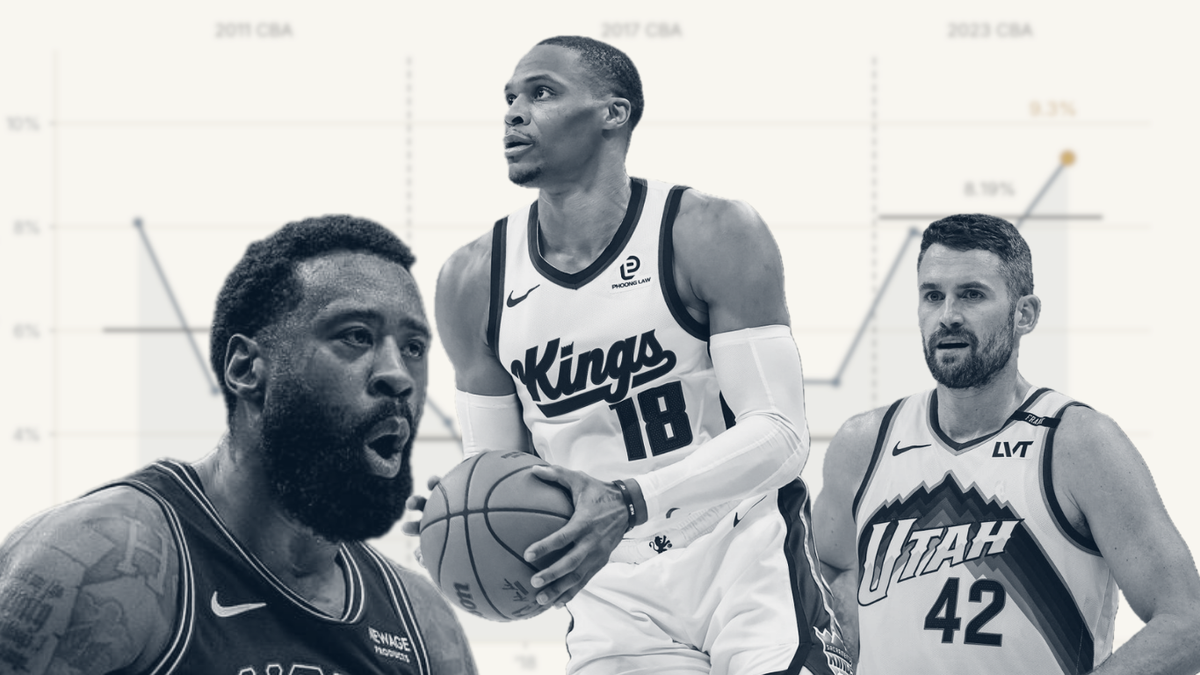
In the wake of the shocking Lakers' sale announcement, CEO of Excel Sports – a power agency – released a statement:
"Incredible, the Lakers sell for $12B, yet teams won't spend on older vets because of current CBA rules. Thank you, Union."
From our Founder & CEO, Jeff Schwartz:
— excel basketball (@excelbasketball) August 12, 2026
"Incredible, the Lakers sell for $12B, yet teams won't spend on older vets because of current CBA rules. Thank you, Union."
Shortly afterward, Excel and Schwartz client, Russell Westbrook announced his retirement after 18 seasons of NBA play.
These two events got me wondering if older veteran players are indeed being squeezed out by the effects of this current CBA. While Schwartz is choosing to direct his ire at the player's union for this iteration of the CBA and its consequences, it's worth investigating if this claim holds up.
Here is a chart of payroll share for players aged 35 or older.
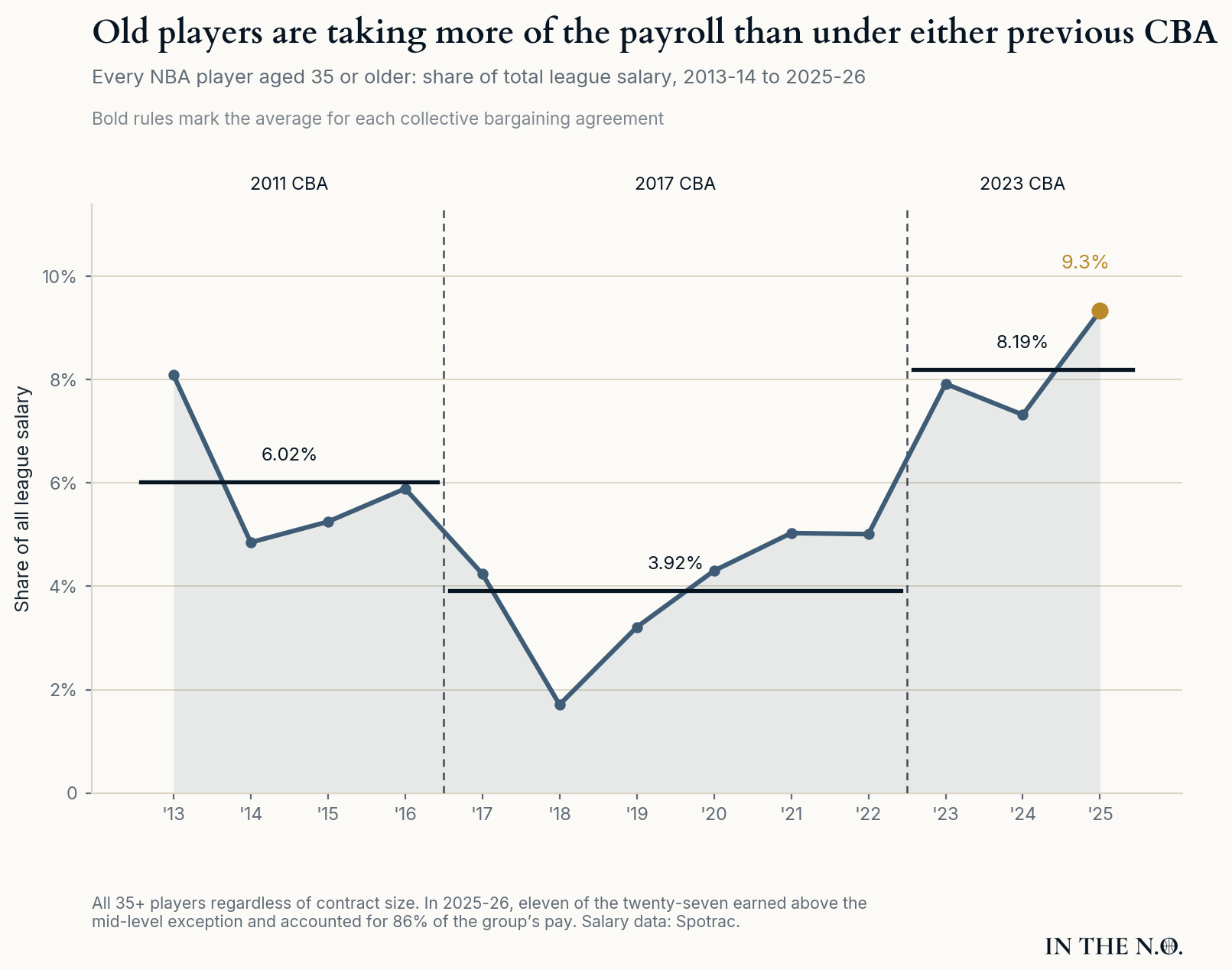
When looking at raw salary data, the 35 and older age cohort is taking a bigger slice of the pie than before. But this is a classic "fat-tail" problem. A lot of this salary share is being driven by the group of highly paid players. Stephen Curry, Kevin Durant, Jimmy Butler, LeBron James, and Paul George were all earning over 30% of the salary cap. Eleven of the twenty-seven aged 35 or older accounted for 86% of the group's pay.
I presume Schwartz's focus is more on the cheaper veteran market, rather than the established stars still earning max deals.
To account for this, I eliminated all players making over the non-taxpayer MLE. This narrows the sample to 207 player-seasons, and gives us cleaner results and two findings.
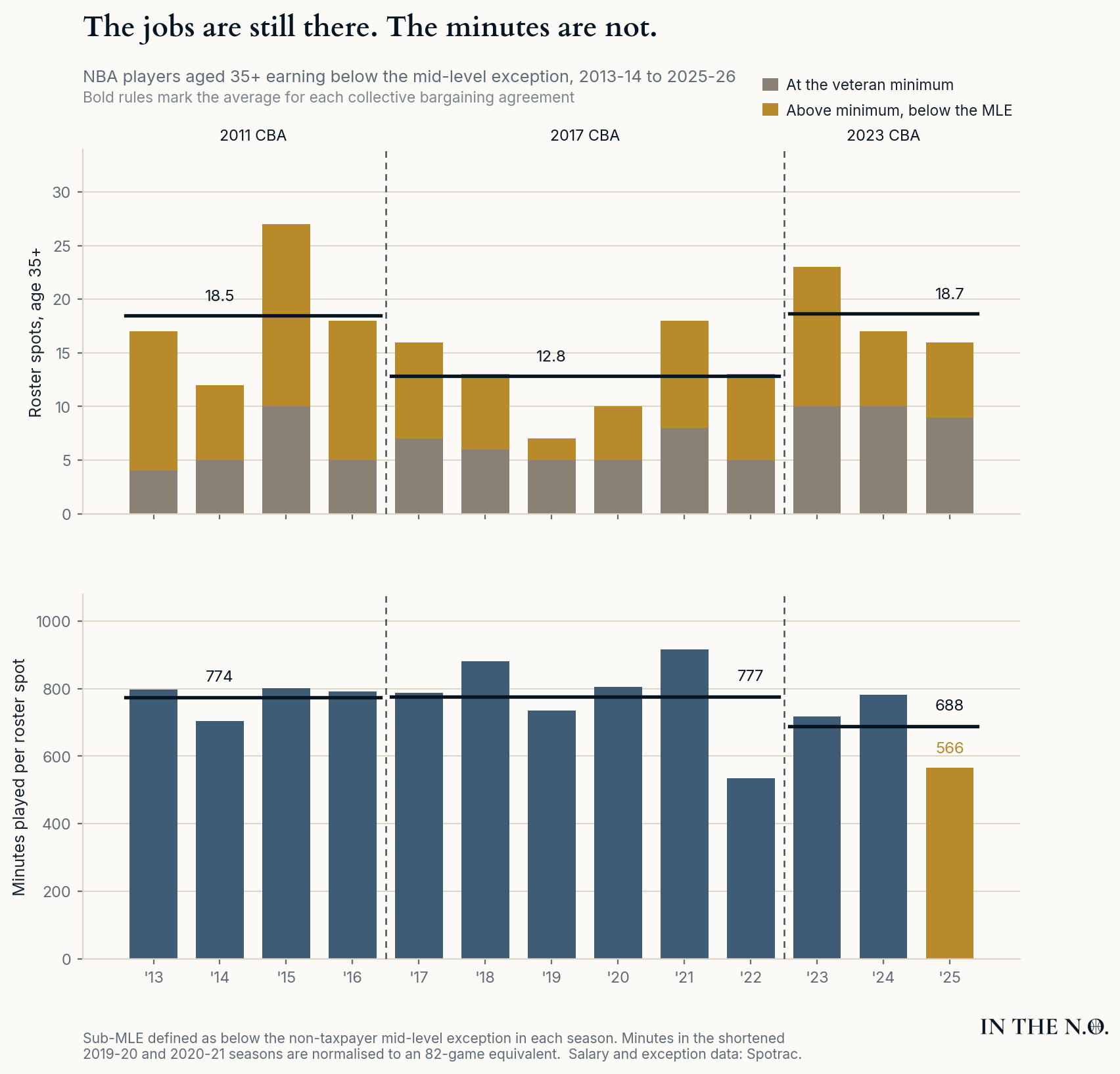
While the roster spots for the 35 and over cohort have gone down slightly over the last couple of years, the average still remains higher than both the 2017 CBA and 2011 CBA average. We have to remember though, these are small samples and there is a decent amount of year-to-year variability.
Where Schwartz and his clients might be feeling it, however, is the opportunity given to vets. Minutes given to this age cohort are down marginally in comparison to the previous two CBAs, with this past year clocking as the lowest of this current CBA.
But could this just be a product of who is actually in the 35 and over sample? If there are more players on the tail end of this age group, could they be skewing the minutes averages? To answer that, I standardized the minutes to age.
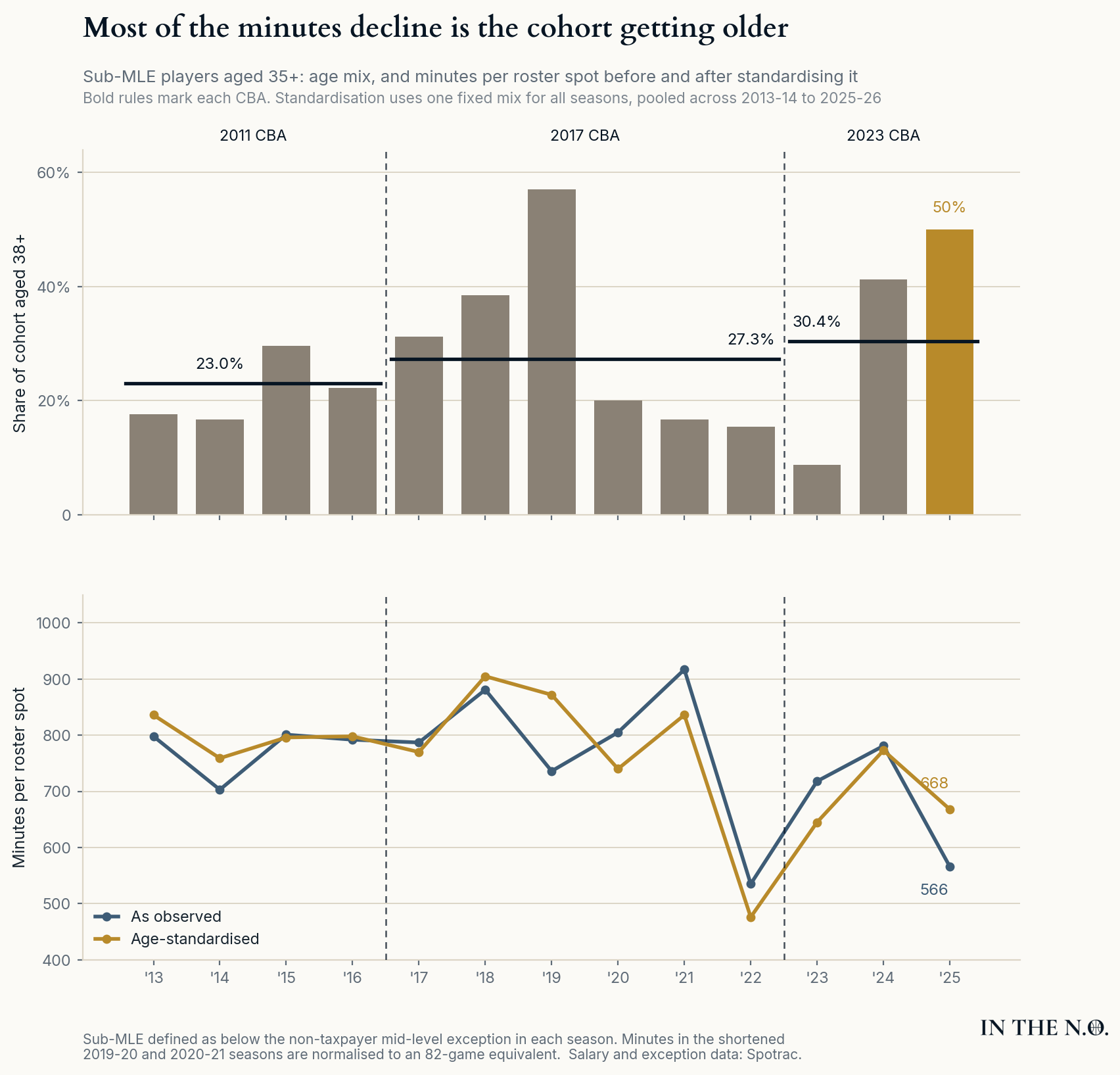
For this past season, we see that 50% of players in the sub-MLE group fall in the 38 and older category. This is the highest mark in six years. Teams are carrying more players into their late thirties than they used to.
The split was an even eight to eight for this past season, but the sub 38 group averaged 782 minutes while the 38+ group averaged 349.
When accounting for this discrepancy across the board and adjusting the weights, we get a revised minutes chart.
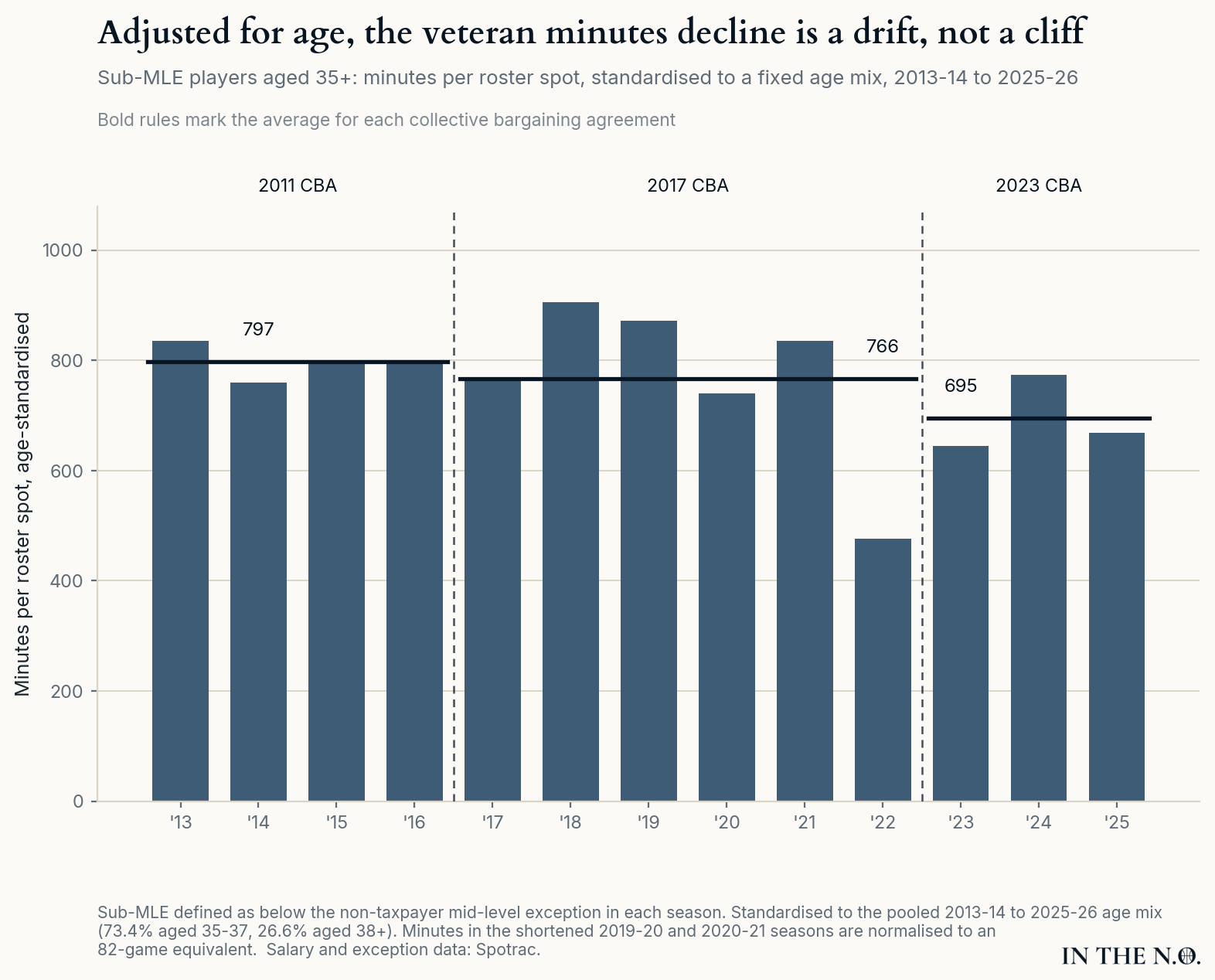
There is a marginal decline in minutes given to cheap older vets compared to the previous two CBAs, but not enough to conclusively say this is a product of the current rules. These averages only cover three seasons so far, so it remains to be seen which direction this trend heads.
Parting Thoughts
The claim that older NBA veterans are getting fewer roster spots due to the current CBA does not hold up to scrutiny. The salary share and overall jobs are both up compared to the previous iteration. It's difficult for me to assign blame to the players' union here when there isn't evidence to support it.
The NBA veteran minimum for a player with a 10 year career is now close to four million dollars, and a big chunk of that is reimbursed by the league. It's never paid better to stick around and we are seeing more players accepting end of bench, culture style roles.
Case in point: Excel and Schwartz client DeAndre Jordan, who is 38 years old, just signed a fully guaranteed two-year deal with the Pelicans. The driving force behind that signing was the cultural value Jordan provides a young group. The opportunities still exist, they just come with fewer minutes.
Moreover, I think this latest criticism of the CBA misses the mark in the same way other popular criticisms do. Owners and teams are not held accountable for being unwilling to spend, and their language has made its way into NBA media. I think the discourse around the aprons and CBA disproportionately puts blame on the players without sufficient pushback. Teams want you to believe their hands are tied due to all these new restrictions, but they don't want people to look deeper into those claims.
Hold the owners accountable. Question their claims. More importantly, always look into what is actually happening to the players.