The Push and Pull Behind Saddiq Bey’s Extension
The declining structure rewards Bey now, restricts a trade this season and gives the Pelicans greater flexibility later.

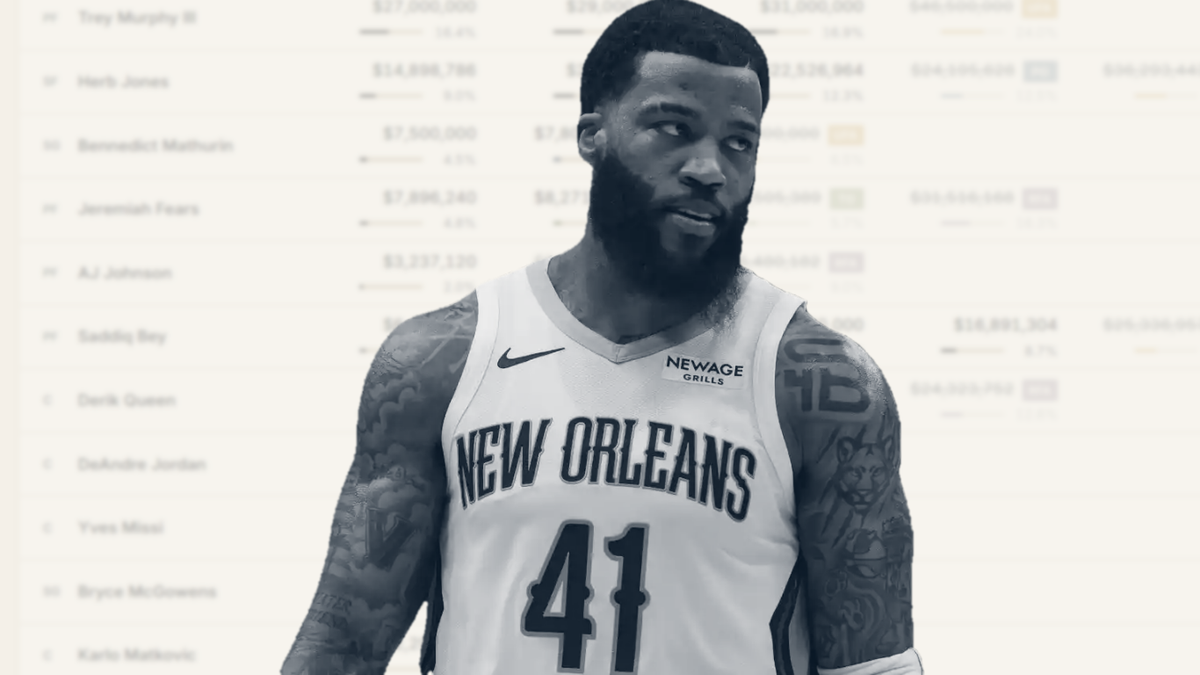
The New Orleans Pelicans and Saddiq Bey agreed to a three-year, $55.5 million contract extension earlier this week. Bey was a bright spot for the Pelicans in a tumultuous season, and it was widely expected the Pelicans would seek to retain him. There are a few details in the contract structure that I want to call attention to, and help illuminate the push and pull of the negotiation. Here are the terms:
- Year 1: $20.1 million
- Year 2: $18.5 million
- Year 3: $16.9 million
- Trade bonus for the lesser of $1 million or 15%
There are three components to this contract that are worth calling out: a three-year deal, declining structure, and trade bonus.
Three-Year Deal
Bey's contract extension puts him on the Pelicans' books through the 2029-30 season. The Pelicans currently have no other contracts which reach this year save for Herb Jones' player option. This is also the season which would potentially be the first year of Jeremiah Fears' and Derik Queen's new deals. Due to the deal's declining structure, Bey will account for roughly 9% of the cap in that final year, which will be near the projected non-taxpayer mid-level exception amount.
The agency secured three fully guaranteed years at a strong number, while the Pelicans avoided guaranteeing a fourth season. That represents a reasonable middle ground for both sides.
Bey was eligible for a maximum of four years, but across the NBA landscape, that length of veteran extension is increasingly being reserved for star or near star level players (unless your name is Gary Trent Jr.).
Naji Marshall's recent three-year, $52.2 million is perhaps the closest comparison. Marshall received a similar commitment without securing a fourth year. Teams have become increasingly reluctant to commit four seasons of guaranteed money to mid-tier veterans, particularly when those contracts overlap with the future decisions involving their core players.
Had Bey chosen to enter free agency next summer, he was unlikely to receive a four-year offer. The Pelicans also likely would not offer a fourth year without making the terms meaningfully worse than this three-year structure (think lower AAV, fewer guarantees, or a team option).
Rui Hachimura and Tobias Harris, who are also Bey's positional comps, were free agents this summer and ultimately signed for lower AAV and only two years each. But those are the dangers of free agency, where they occupy a different segment of the market. That uncertainty is precisely why I think Bey did well to accept this deal.
Declining Structure
This is perhaps the most fascinating note. While most contracts have standard year-to-year increases, its not uncommon for there to be other structures, including declining. Typically, the agency is focused on securing the most guaranteed money possible in terms of years and AAV. Once that is secured, the structure of the contract is often flexible given team needs. Agencies do have to be careful, however, because the final year of the contract is the anchor point for future extension conversations. Under the current CBA, Bey will be limited to 140% of the $16.9 million amount in the final year, as that amount should come in higher than the estimated average player salary (EAPS).
Secondly, the structure places a 6 month trade restriction on Bey. The $20.1 million starting salary and the 8% annual declines each exceed the criteria necessary for extend-and-trade agreements.
This means the Pelicans cannot trade Bey this trade deadline. The Pelicans could have reached the total contract amount while keeping Bey trade eligible if they wished, but it's clear the Pelicans want a declining structure and have no plans for trading Bey anytime soon. The Pelicans traded immediate trade eligibility for flexibility on the backend.
The interesting part of this, however, is that the fact the Pelicans intentionally sought this declining structure. Looking ahead to when this extension kicks in, the Pelicans currently project to have enough room under the tax to absorb Bey's $20.1 million frontloaded hit, even if Murray and Mathurin return. That cushion would largely disappear if New Orleans turned Poole's expiring salary into a comparable long-term contract. The declining structure, therefore looks less like an attempt to manufacture immediate flexibility and more like an effort to make Bey progressively cheaper after the next major acquisition or extension is already on the books.
This could mean another Zion Williamson extension, which I still believe is likely. It could also mean acquiring a player with multiple years remaining, or trading for someone the Pelicans intend to extend. Either way, New Orleans appears to be protecting the seasons in which its next major financial commitment would begin.
Trade Bonus
The trade bonus is a clear win for the agency. There are a couple of things here that are worth unpacking.
First, the language. The bonus is for the lesser of $1 million or 15% of the base compensation remaining on Bey's contract at time of trade. The practical bonus will be $1 million through nearly all of the deal, although the percentage could produce a lower amount if he were traded late in the final season. The CBA requires a fixed-dollar trade bonus to be capped by a percentage, and 15% is the maximum allowed.
One example of a similar situation is Jaylen Brown having a trade kicker for the lesser of $7 million or 7%, which was his jersey number.
But the kicker is a clear, client-facing win. Trades are never fun, but getting a bonus million dollars can help with the mood. They can also trigger phone calls to agencies before a trade, because sometimes the other team needs the player to waive the kicker to make the money work.
For the Pelicans, they will be on the hook for paying out the bonus if they choose to trade Bey. This does not show up on their cap sheet, but will come out of Gayle Benson's pocket. I presume this was a fairly easy conversation for Dumars to have with Benson since it is a relatively small amount.
Parting Thoughts
I think the agency did well on this deal, and while I think there was a slight overpay from the Pelicans, they did pretty well too. From the agency side, there just isn't a high probability Bey was netting this in free agency, even with more teams having cap space next year. Only one player got over $20 million per year in unrestricted free agency this year, and that was Norman Powell. And only one year of that deal is guaranteed, as the second year is a team option.
Bey is also a player who has not had a major payday yet, and is likely motivated to get an extension done. Through that lens, I would give the agency an A- for the deal, with the only real quibble being the declining structure. I don't think a higher AAV was on the table, and I don't think more years were either. Bey will be 30 years old at the end of this contract, heading into his age 31 season. This gives him room to secure another deal that will carry him towards the twilight of his career.
For the Pelicans, I would give this deal a B+. All in all, they retained a good player who brings a lot of cultural value. I give them points for the declining structure, and I think three years is pretty fair for a guy you want to keep. I think the trade bonus was something they probably could have pushed back on, but is minor in the grand scheme of the negotiation.
Where my concerns primarily lie are with the valuation of Saddiq as a player. While a productive offensive player, I project him more as a bench piece than a long-term starter. Saddiq is capable of absorbing usage and creating shots in the post, which is a plus, but he's been around league average to below league average efficiency his whole career. The impact on the team's offense doesn't scale with more shots, and the playmaking isn't there to make up the gap.
Defensively is where I have the larger concern. Bey doesn't provide much help on the perimeter as a defender, and is better suited matching up against slower and stronger players. Though last season was his first season back from a prolonged injury-related absence, and how he fares in Mosley's schemes will tell me a lot about how this contract will play out.
Overall, Bey was a highly enjoyable presence last year and exceeded my expectations greatly. I did not expect him to be such a valuable creator in post-up situations, and he often was the Pelicans closer in tough games. If he continues to build on last season, this will become a super valuable contract.